
Choose language / Välj språk
English brewing instructions
About Upbeat Czech Pilsner
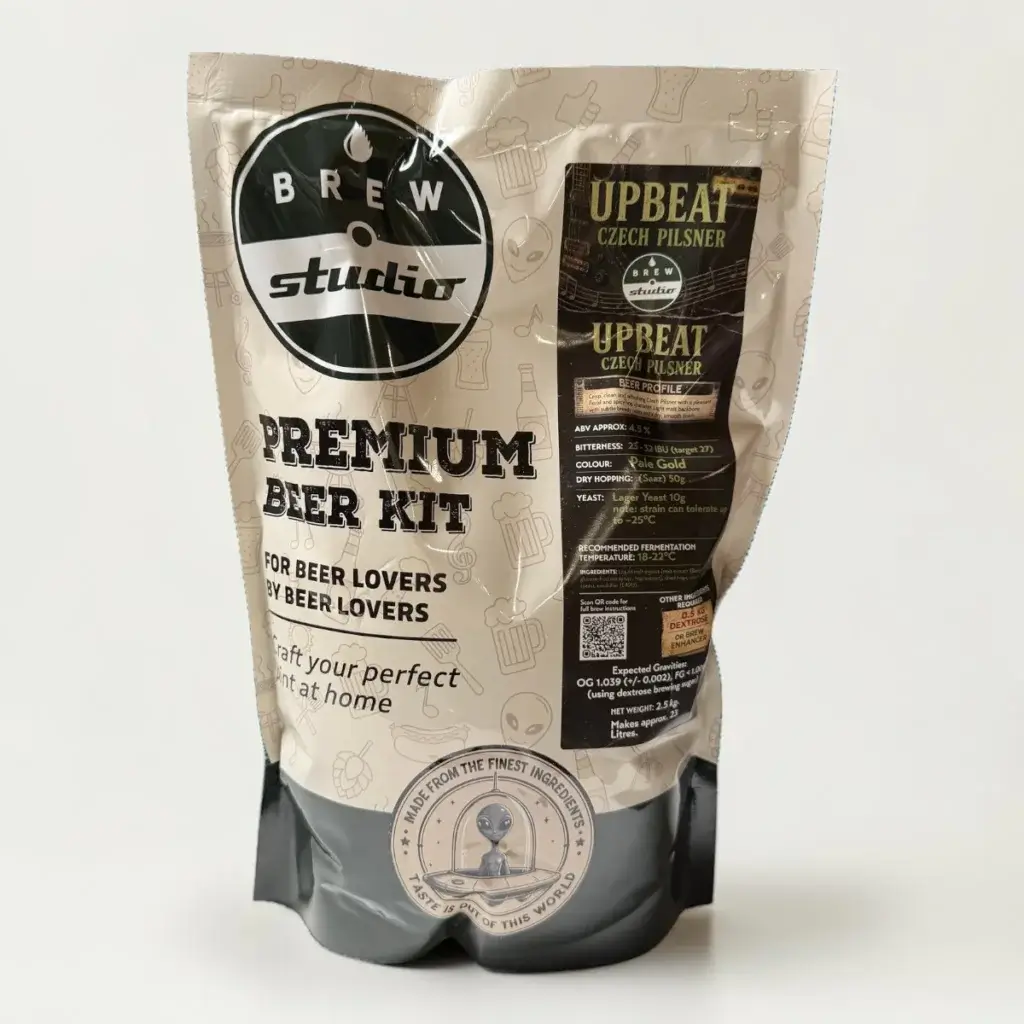
Upbeat Czech Pilsner is a premium beer kit based on a recipe from Beer Studio in northern Sweden. It contains a carefully composed blend of malt extracts, a generous amount of classic Saaz hops and a selected lager yeast capable of fermenting at temperatures up to approximately 25°C.
The result is a crisp and clean pilsner with a light malt character and smooth bitterness. A pale, refreshing and well-balanced pilsner in the classic Czech style.
Beer specifications
- Expected ABV: approximately 4.5%
- Final volume: 23 litres
- Bitterness: approximately 27 IBU (23–32 IBU)
- Colour: pale golden
- Hops: Saaz – 50 g in total
- Yeast: selected lager yeast – 10 g
- Expected OG: 1.039 ± 0.002
- Expected FG: below 1.006 when using dextrose
You also need
Primary fermentation: 500 g of dextrose/brewing sugar or Brew Enhancer.
Bottle carbonation: 5 g of white granulated sugar per litre of beer.
Equipment needed
- Fermentation vessel with a minimum capacity of 28 litres
- Lid with fitted airlock
- Large mixing spoon or paddle
- Immersion thermometer or thermometer strip
- Hydrometer and sample jar
- Siphon kit
- Equipment cleaner and sanitiser
- Up to 45 pressure-resistant 500 ml brown glass or PET beer bottles
- Suitable swing-top, screw-top or crown-cap closures
- Small funnel for bottling sugar, if required
Step 1: Clean and sanitise
Clean and sanitise the fermentation vessel, lid, mixing spoon or paddle, thermometer, hydrometer and all other equipment that will come into contact with the beer.
Step 2: Open the pouch
- Carefully cut open the pouch.
- Remove the yeast and hop sachets from the dry compartment.
- Set the sachets aside for later use.
Step 3: Add the malt extract
- Pour all the liquid malt extract from the wet compartment into the fermentation vessel.
- Roll and squeeze the pouch to remove as much extract as possible.
- Rinse the pouch with a small amount of warm water and add the rinsing water to the vessel.
Step 4: Add the hot water and dextrose
- Boil 3 litres of tap water and carefully pour it into the fermentation vessel.
- Add 500 g of dextrose/brewing sugar or Brew Enhancer.
- Stir thoroughly until fully dissolved.
Step 5: Fill to 23 litres
- Top up with cold tap water until the total volume reaches 23 litres.
- Stir continuously for 5 minutes to mix thoroughly.
Important: The total volume in the fermentation vessel should be 23 litres. Do not add 23 litres of water in addition to the malt extract and the first 3 litres of water.
Step 6: Measure the OG and add the yeast
- Check that the temperature is between 18 and 24°C.
- Measure the original gravity with a sanitised hydrometer. The expected OG is 1.039 ± 0.002.
- Sprinkle the entire 10 g lager yeast sachet evenly over the liquid surface.
- Do not stir after adding the yeast.
Step 7: Begin fermentation
- Fasten the lid securely to the fermentation vessel.
- Insert the airlock containing water.
- Leave the beer to ferment at 18–24°C for 5 days.
Temperature: The selected lager yeast can tolerate temperatures up to approximately 25°C, but the recommended fermentation range is 18–24°C.
Step 8: Add the Saaz hops after 5 days
- After 5 days of fermentation, carefully remove the lid.
- Sprinkle all 50 g of Saaz hop pellets onto the liquid surface.
- Do not stir.
- Immediately refasten the lid and leave the beer to continue fermenting.
Step 9: Check that fermentation is complete
Fermentation normally takes approximately 7–10 days in total. Check the specific gravity periodically with a sanitised hydrometer after the hop addition.
The expected final gravity is below 1.006 when 500 g of dextrose is used.
Important: Do not bottle the beer until the gravity is below 1.006 and has remained stable for 2–3 consecutive days.
If Brew Enhancer is used instead of dextrose, the final gravity may be approximately 2–4 points higher and the resulting ABV may be slightly lower.
Step 10: Bottle the beer
- Clean and sanitise the bottles, closures, siphon and any other bottling equipment.
- Only use reusable brown glass or PET bottles designed to withstand the pressure of bottle-conditioned beer.
- Do not use damaged or imperfect bottles.
- Add 5 g of white granulated sugar per litre of beer.
- Transfer the beer into the bottles using a sanitised siphon.
- Fill each bottle approximately to the shoulder, leaving the neck empty for carbonation.
- Avoid transferring sediment from the bottom of the fermentation vessel.
- Seal each bottle securely.
- Shake each sealed bottle to dissolve the sugar.
Carbonation sugar examples
- 330 ml beer: approximately 1.65 g sugar
- 500 ml beer: 2.5 g sugar
- 750 ml beer: 3.75 g sugar
- 1 litre beer: 5 g sugar
Step 11: Carbonate and condition
- Store the bottles upright at 18–24°C for at least 2 weeks.
- Move the bottles to a cooler place for another 2 weeks.
- The beer will then be ready to drink.
Serving
Serve the beer chilled. Pour slowly and carefully in one continuous motion to avoid transferring the yeast sediment from the bottom of the bottle into the glass.
Package contents
- Liquid malt extract blend
- 50 g Saaz hop pellets
- 10 g selected lager yeast
- Instructions
Ingredients and storage
Ingredients: Liquid malt extract [malt extract (barley), glucose-fructose syrup, hop extract], dried hops, dried yeast [yeast, emulsifier (E491)].
For allergens, see ingredients in bold.
Store in a cool, dry place away from direct sunlight. Packaged in a protective atmosphere. Packed in the United Kingdom.
Svenska brygginstruktioner
Om Upbeat Czech Pilsner
Upbeat Czech Pilsner är en premiumölsats baserad på ett recept från Beer Studio i Norrland. Ölsatsen innehåller en noggrant sammansatt blandning av maltextrakt, rikligt med klassisk Saaz-humle och en utvald lagerjäst som klarar jäsning vid temperaturer upp till cirka 25°C.
Resultatet är en krispig och ren pilsner med en lätt maltkaraktär och mjuk beska. En ljus, uppfriskande och välbalanserad pilsner i klassisk tjeckisk stil.
Ölets egenskaper
- Förväntad alkoholhalt: cirka 4,5 %
- Färdig volym: 23 liter
- Bitterhet: cirka 27 IBU (23–32 IBU)
- Färg: ljust gyllene
- Humle: Saaz – totalt 50 g
- Jäst: utvald lagerjäst – 10 g
- Förväntat OG: 1.039 ± 0.002
- Förväntat FG: under 1.006 vid användning av dextros
Du behöver också
För huvudjäsningen: 500 g dextros/bryggsocker eller Brew Enhancer.
För kolsyresättningen: 5 g vanligt vitt strösocker per liter öl.
Utrustning du behöver
- Jäskärl som rymmer minst 28 liter
- Lock med monterat jäsrör
- Stor slev eller omrörare
- Termometer eller termometerremsa
- Hydrometer och mätglas
- Hävert
- Rengörings- och desinfektionsmedel
- Upp till 45 trycktåliga bruna glasflaskor eller PET-flaskor à 500 ml
- Lämpliga patentkorkar, skruvkorkar eller kapsyler
- Liten tratt för flaskningssockret, om det behövs
Steg 1: Rengör och desinficera
Rengör och desinficera jäskärlet, locket, sleven eller omröraren, termometern, hydrometern och all annan utrustning som kommer i kontakt med ölet.
Steg 2: Öppna påsen
- Klipp försiktigt upp förpackningen.
- Ta ut påsarna med jäst och humle ur det torra facket.
- Lägg dem åt sidan för senare användning.
Steg 3: Tillsätt maltextraktet
- Häll allt flytande maltextrakt från det våta facket i jäskärlet.
- Rulla och pressa påsen för att få ut så mycket maltextrakt som möjligt.
- Skölj ur påsen med lite varmt vatten och häll även sköljvattnet i jäskärlet.
Steg 4: Tillsätt varmt vatten och dextros
- Koka upp 3 liter kranvatten och häll det försiktigt i jäskärlet.
- Tillsätt 500 g dextros/bryggsocker eller Brew Enhancer.
- Rör om ordentligt tills allt har lösts upp.
Steg 5: Fyll upp till 23 liter
- Fyll på med kallt kranvatten tills den totala volymen är 23 liter.
- Rör om i 5 minuter så att allt blandas ordentligt.
Viktigt: Den totala volymen i jäskärlet ska vara 23 liter. Tillsätt alltså inte 23 liter vatten utöver maltextraktet och de första 3 literna vatten.
Steg 6: Mät OG och tillsätt jästen
- Kontrollera att temperaturen är 18–24°C.
- Mät ölets originaldensitet med en desinficerad hydrometer. Förväntat OG är 1.039 ± 0.002. Här kan du läsa hur du läser av en hydrometer.
- Strö hela påsen med 10 g lagerjäst jämnt över vätskans yta.
- Rör inte om efter att jästen har tillsatts.
Steg 7: Påbörja jäsningen
- Sätt fast locket ordentligt på jäskärlet.
- Montera jäsröret med vatten.
- Låt ölet jäsa vid 18–24°C i 5 dagar.
Temperatur: Den utvalda lagerjästen klarar temperaturer upp till cirka 25°C, men det rekommenderade jästemperaturintervallet är 18–24°C.
Steg 8: Tillsätt Saaz-humlen efter 5 dagar
- Ta försiktigt av locket efter 5 dagars jäsning.
- Strö alla 50 g Saaz-humlepellets över vätskans yta.
- Rör inte om.
- Sätt omedelbart tillbaka locket och låt ölet fortsätta jäsa.
Steg 9: Kontrollera att jäsningen är färdig
Jäsningen tar normalt cirka 7–10 dagar totalt. Kontrollera densiteten regelbundet med en desinficerad hydrometer efter att humlen har tillsatts.
Förväntat FG är under 1.006 när 500 g dextros används.
Viktigt: Tappa inte ölet på flaska förrän densiteten är under 1.006 och har varit stabil i 2–3 dagar i följd.
Om Brew Enhancer används i stället för dextros kan FG bli cirka 2–4 punkter högre och alkoholhalten något lägre.
Steg 10: Tappa ölet på flaska
- Rengör och desinficera flaskor, förslutningar, hävert och övrig flaskningsutrustning.
- Använd endast återanvändbara bruna glasflaskor eller PET-flaskor avsedda för trycket från flaskjäst öl.
- Använd inte skadade eller defekta flaskor.
- Tillsätt 5 g vanligt vitt strösocker per liter öl.
- Tappa ölet på flaskorna med hjälp av en desinficerad hävert.
- Fyll flaskorna ungefär till flaskans skuldra och lämna halsen tom för kolsyresättningen.
- Undvik att få med bottensatsen från jäskärlet.
- Förslut varje flaska ordentligt.
- Skaka varje försluten flaska så att sockret löses upp.
Exempel på sockermängd
- 330 ml öl: cirka 1,65 g strösocker
- 500 ml öl: 2,5 g strösocker
- 750 ml öl: 3,75 g strösocker
- 1 liter öl: 5 g strösocker
Steg 11: Kolsyresättning och lagring
- Förvara flaskorna stående vid 18–24°C i minst 2 veckor.
- Flytta därefter flaskorna till en svalare plats i ytterligare 2 veckor.
- Ölet är sedan färdigt att dricka.
Servering
Servera ölet väl kylt. Häll långsamt och försiktigt i en sammanhängande rörelse så att jästfällningen i flaskans botten inte följer med ner i glaset.
Förpackningens innehåll
- Flytande maltextrakt
- 50 g Saaz-humlepellets
- 10 g utvald lagerjäst
- Instruktioner
Ingredienser och förvaring
Ingredienser: Flytande maltextrakt [maltextrakt (korn), glukos-fruktossirap, humleextrakt], torkad humle, torkad jäst [jäst, emulgeringsmedel (E491)].
För allergener, se ingredienser i fetstil.
Förvaras svalt och torrt, skyddad från direkt solljus. Förpackad i skyddande atmosfär. Packad i Storbritannien.
Recent Comments